High Ferroelectricity: First Method for Production of Bulk SnTiO3
Innovative Products and Technologies
The invention presents the first scalable method for producing bulk SnTiO3, a material with remarkable ferroelectric properties. Previously limited to thin films due to the instability of tin(II) oxide at high temperatures, this method circumvents these limitations, enabling industrial-scale synthesis. The new process produces high-purity SnTiO3 with unique crystalline structures, expanding its applicability across ferroelectric, piezoelectric, and electro-optical devices. This breakthrough facilitates the development of advanced electronics such as FeRAM, tunable capacitors, and precision actuators, marking a significant advancement in materials science and technology.
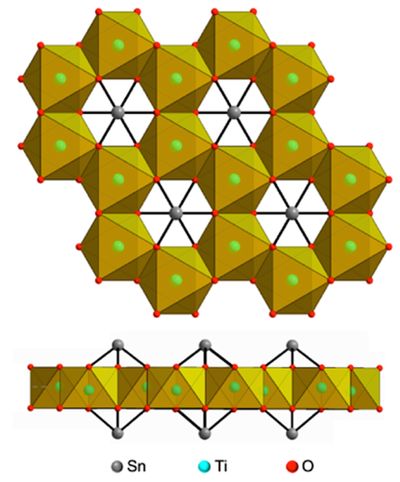
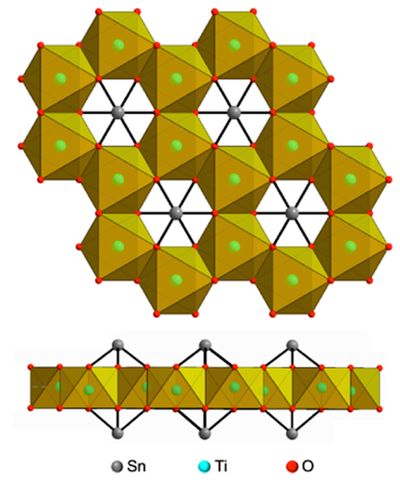
Figure 1:Illustration of the crystal structure of SnTiO3. The newly developed method according to the invention allows for the large-scale preparation of this bulk material. It is favorable for various applications, especially due to its ferroelectric properties (Diehl, et al., 2018).
Background
SnTiO3, a promising ferroelectric material, has historically been challenging to synthesize in bulk form. Existing methods like atomic layer or pulsed laser deposition are restricted to thin films, limiting their scalability and application. Additionally, traditional approaches requiring high temperatures lead to unwanted decomposition of tin(II) oxide. This new method overcomes these challenges, allowing for the cost-effective production of SnTiO3 in bulk, addressing the industry's demand for scalable, versatile materials with superior properties.
Technology
This invention provides a novel, scalable method for producing bulk SnTiO3 with high purity and unique crystalline structures. The process begins by reacting an alkali metal salt with titanium(IV) oxide at 550–650°C over a duration of 12 hours to create a layered alkali metal titanate. The precursor undergoes an ion exchange where tin(II) ions replace the alkali metal ions, forming a tin-exchanged titanate. Finally, the material is dehydrated and annealed below 350°C in an oxygen-free environment, preventing the decomposition of tin(II) oxide and enabling the formation of bulk SnTiO3. The method also facilitates the production of new crystalline structures, such as SnTi1-xMxO3. This approach ensures reproducibility, high material quality, and industrial scalability, addressing the limitations of traditional methods restricted to thin films.
Advantages
Potential applications
Patent Information
PCT (WO2019211372A1; 02.05.2019), active in EP, CN, JP, US
Publications
Diehl, L., Bette, S., Pielnhofer, F., Betzler, S., Moudrakovski, I., Ozin, G. A., ... & Lotsch, B. V. (2018). Structure-directing lone pairs: synthesis and structural characterization of SnTiO3. Chemistry of Materials, 30(24), 8932-8938.
PDF Download
Dr. Bernd Ctortecka, M. Phil.
Physicist
Senior Patent- & License Manager
Email: ctortecka@max-planck-innovation.de
As the central technology transfer company of the Max Planck Society, Max Planck Innovation has helped bridge the gap between science and industry since 1970.
The Max Planck Society (MPG) operates as Germany’s most successful organization in basic research and is worldrenowned for its cutting-edge research. In many cases this cutting-edge research also forms the basis for innovative products and services that are implemented through licensing and spin-off companies.
Max-Planck-Innovastion advises and supports scientists of the Max Planck Society in the assessment of inventions and filing of patents. We also market patents and technologies to industry, while coaching founders on how to build up new companies based on the research results of the Max Planck Society.

Create your free account to connect with Lars Cuypers and thousands of other innovative organizations and professionals worldwide
Send a request for information
to Lars
Technology Offers on Innoget are directly posted
and managed by its members as well as evaluation of requests for information. Innoget is the trusted open innovation and science network aimed at directly connect industry needs with professionals online.
Need help requesting additional information or have questions regarding this Technology Offer?
Contact Innoget support