Smart Heat Management with Core-Shell Catalyst Pellets: Preventing Hotspots, Maximizing Yield
Patents for licensing
Prof. Kai Sundmacher and co-workers at the MPI for Dynamics of Complex Technical Systems developed a novel core-shell catalyst design with a highly active catalyst core surrounded by an inert, low-permeability shell. The new catalyst design leads to an intrinsic heat management that avoids hotspots in strongly exothermic reactions. This allows faster reactor start-up and shut-down and makes the catalysts suitable for rapid load changes in discontinuous processes that are currently discussed for Power-to-X processes based on renewable energy sources like wind or solar. The novel catalyst design is based on computer similations but we already reproduced the calculated performance with real core-shell design catalysts in the laboratory.
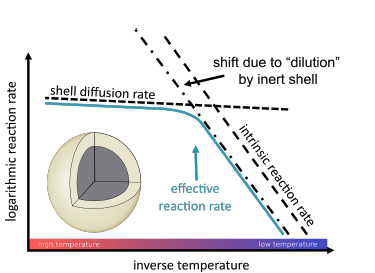
Prof. Kai Sundmacher and Dr.-Ing. Ronny Zimmermann, together with their team at the Max Planck Institute for Dynamics of Complex Technical Systems, have developed and patented a novel core-shell catalyst pellet that fundamentally redefines how exothermic reactions are controlled at the pellet scale.
The core-shell pellet consists of a highly active catalytic core sourounded in an inert, low-permeability shell. The design adapts to the thermal operating regime of the reactor:
At low temperatures, the shell has minor influence, and the full catalytic activity of the core is utilized - ensuring high reaction rates and space-time yields.
This self-regulating mechanism of the pellets offers a robust and passive safety feature against thermal runaway, especially for -but not limited to- dynamic operating scenarios. As a result, the novel pellet design combines high performance with intrinsic thermal stability - without the need for conventional trade-offs such as feed or fixed-bed dilution.
Scalability and Customization
Figure2: Core-shell catalyst pellet samples produced by fluidized-bed coating. |
The core-shell catalyst pellet design is practically and economically viable. It can be manufactured cost-effectively at pilot and industrial scale using established coating methods such as fluidized-bed coating. This ensures ‘’drop-in” integration into existing production lines.
The shell properties (e.g., porosity, pore size, and thickness) can be tuned to meet the specific requirements of a given reaction system (see Fig. 2). This opens up a wide application range, from thermally sensitive lab-scale studies to high-throughput production in large-scale fixed-bed reactors.
Case Study: CO2 Methanation
To demonstrate the performance and technical feasibility of the core-shell catalyst pellet concept, a series of computational and experimental studies [1–5] were conducted using CO₂ methanation as a showcase. This reaction is highly exothermic and is widely recognized as a benchmark process where thermal management is critical to ensure selectivity, stability, and catalyst lifetime.
Figure3: The core-shell catalyst pellet concept applied to CO2 methanation: Simulation studies (left) and pilot-reactor experiments (right) (tube length: 2 m; tube diameter: 2 cm). In both cases, a significant decrease of the hot-spot temperature is observed.
Simulation results and pilot-scale experiments consistently confirm the temperature-limiting function of the core-shell catalyst pellets at elevated operating conditions. The shell’s mass transport resistance significantly reduces hotspot temperatures, leading to stable and well-distributed temperature profiles across the fixed-bed - while still achieving high methane yields.
Compared to conventional methanation process concepts - such as fixed-bed dilution, recycle loops, intercooling or distributed feed injection - the core-shell pellet demonstrates multiple key advantages [2,4]:
With this performance, the core-shell concept enables product qualities comparable to multi-stage systems, but within a single-stage, multi-tubular fixed-bed reactor. Ultimately, the simpler process configuration will lead to lower capital and operating costs, as well as significantly higher load flexibility.
Additional so far unpublished methanation data is available, that could be provided under a CDA.
Further Applications
The core-shell catalyst pellet design is not limited to CO₂ methanation. As a generalizable heat management concept, it holds strong potential for a wide range of highly exothermic catalytic processes, where thermal runaway and hotspot formation pose significant challenges. Promising application fields include: Fischer-Tropsch synthesis (GTL processes), sulfuric acid production (SO₂ oxidation), methanol synthesis, ammonia synthesis.
Get in touch with us to discuss how this technology can be tailored to your specific process challenges.
Current development status
Laboratory prototypes
Applications
Catalyst design with intrinsic heat management for exothermic reactions
Desired business relationship
Patent licensing
Technology development
As the central technology transfer company of the Max Planck Society, Max Planck Innovation has helped bridge the gap between science and industry since 1970.
The Max Planck Society (MPG) operates as Germany’s most successful organization in basic research and is worldrenowned for its cutting-edge research. In many cases this cutting-edge research also forms the basis for innovative products and services that are implemented through licensing and spin-off companies.
Max-Planck-Innovastion advises and supports scientists of the Max Planck Society in the assessment of inventions and filing of patents. We also market patents and technologies to industry, while coaching founders on how to build up new companies based on the research results of the Max Planck Society.

Create your free account to connect with Lars Cuypers and thousands of other innovative organizations and professionals worldwide
Send a request for information
to Lars
Technology Offers on Innoget are directly posted
and managed by its members as well as evaluation of requests for information. Innoget is the trusted open innovation and science network aimed at directly connect industry needs with professionals online.
Need help requesting additional information or have questions regarding this Technology Offer?
Contact Innoget support