Dual-curing system for advanced processing in 3d printing
Innovative Products and Technologies

Vat photopolymerization 3D printing offers high resolution, surface quality, and geometric precision, benefiting industries like automotive, aerospace, medical, and R&D. However, challenges in scaling and material performance persist. A dual-curing acrylic-epoxy system addresses these issues, enabling low shrinkage, high mechanical properties, and post-processing flexibility, offering a scalable, robust solution for demanding structural applications.
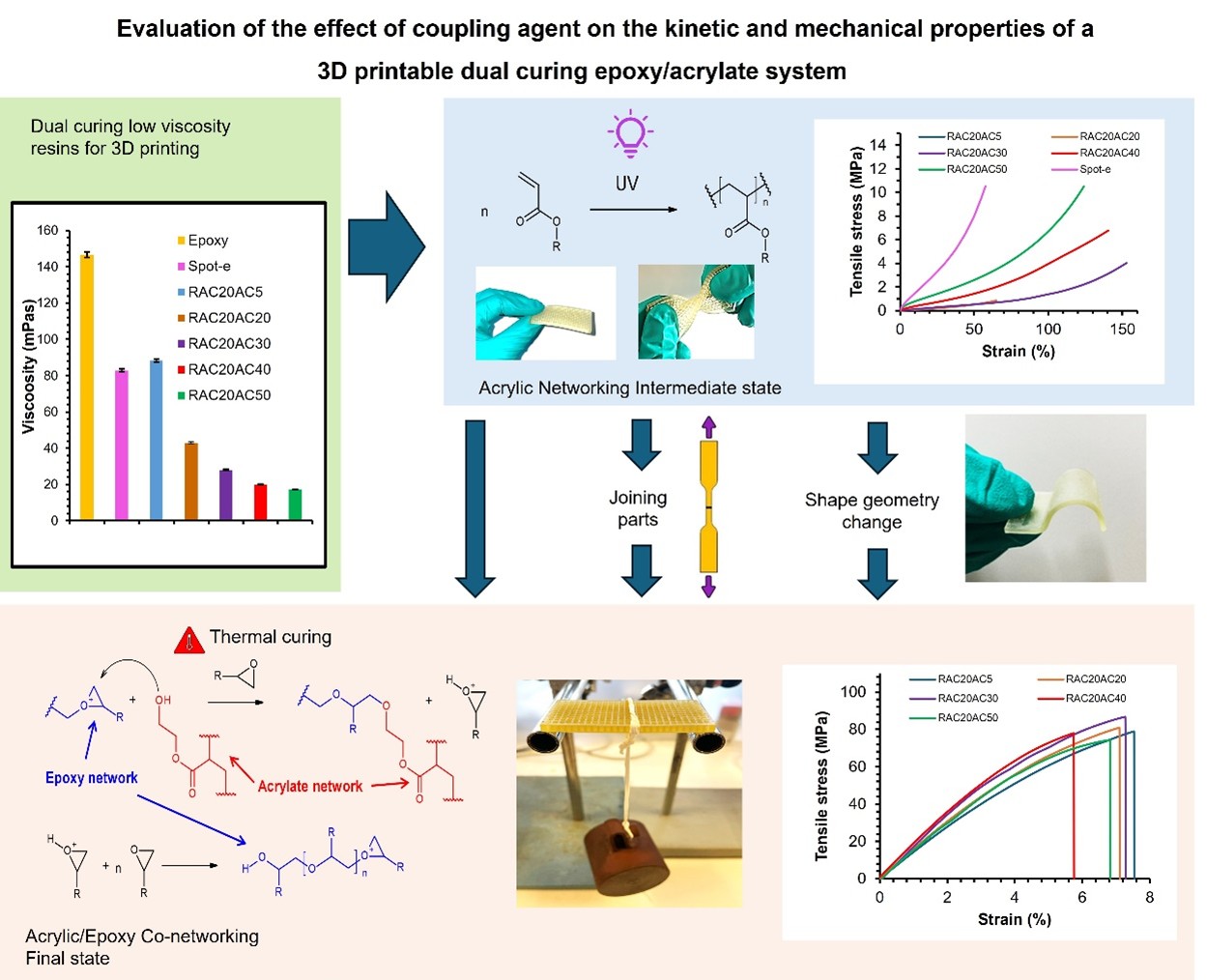
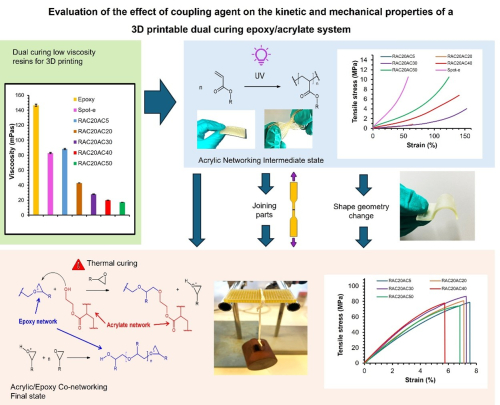
The foundation of this methodology lies in the use of dual-curing, a technique that enables controlled and sequential reactions for processing the formulation. Initially, radical polymerization is triggered by light in the VPP printer, activating acrylate or methacrylate functionalities that react with themselves to form an initial polymer network. The proper selection and control of acrylate and methacrylate functionalities allow for the formulation of a low-viscosity solution, which facilitates printing. A second curing stage is subsequently activated through a temperature-induced cationic reaction. In this step, an epoxy resin is used to densify the network and enhance its mechanical properties. Additionally, a low-molecular-weight polyol, present in liquid phase, is incorporated into the formulation to contribute to the network architecture. This dual-curing strategy provides high versatility in the design of polymer networks, as the appropriate dosing of components enables the tailoring of final mechanical properties. Moreover, the use of low-viscosity formulations significantly improves processability without compromising reactivity.
Potential advantages and innovations
From a processing perspective, this methodology enables the formulation of solutions with low viscosities and high reactivity key characteristics for vat photopolymerization (VPP) 3D printing technologies. These properties facilitate efficient and rapid shaping, which is essential for maintaining print quality. Additionally, the technology allows the production of parts with high resolution, excellent surface finish, and remarkable geometric accuracy, thanks to the low volumetric shrinkage of the developed materials.
Moreover, the dual-curing approach provides significant versatility in material design, enabling the development of networks with either high or low glass transition temperatures (Tg), depending on the selected polymer architecture. Mechanical properties can also be tailored: it is possible to formulate rigid materials with tensile strengths approaching 80 MPa, as well as flexible systems capable of withstanding strain values above 70%. This degree of customization represents a substantial added value in the development of materials for targeted applications.
Market and applications
The developed acrylic/epoxy systems for vat photopolymerization serves industries like automotive, aerospace, medical, jewelry, and R&D, requiring high precision, strength, and complex geometries. Suitable for rigid and flexible parts, they offer scalable, customizable solutions. The VPP 3D printing market is projected to grow from USD 2.73B in 2025 to USD 8.69B by 2030, with a CAGR of 26.02%, reflecting its rapid industrial adoption.
Intellectual property status
Granted Utility model U202431191 - 20/06/2024
Patent application number : PCT/ES2025/070360 - 17/06/2025
Current development status
Extensive characterization of various acrylic/epoxy systems has been performed, including processing, physicochemical, thermal, and mechanical analyses. Results show excellent properties and precise control over mechanical behavior. The study covers a wide range of materials, from rigid with high tensile strength to flexible with high deformation, enabling tailored solutions for diverse industrial applications.
Desired business relationship
Patent licensing
Technical cooperation
The Technology Transfer and Innovation Center (CTTi) provides solutions to the technological and service needs of both productive sectors and public administration. Its work focuses on managing technology and knowledge transfer, protecting intellectual property rights, promoting entrepreneurship and offering specialized infrastructure for innovation transfer.
Create your free account to connect with Unitat de Valorització de la URV and thousands of other innovative organizations and professionals worldwide
Send a request for information
to Unitat
Technology Offers on Innoget are directly posted
and managed by its members as well as evaluation of requests for information. Innoget is the trusted open innovation and science network aimed at directly connect industry needs with professionals online.
Need help requesting additional information or have questions regarding this Technology Offer?
Contact Innoget support