Electroactive compounds for improved stability in redox flow batteries
Patents for licensing

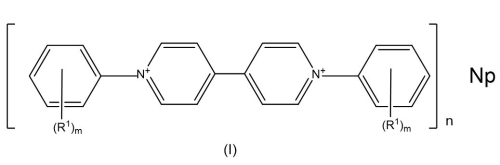
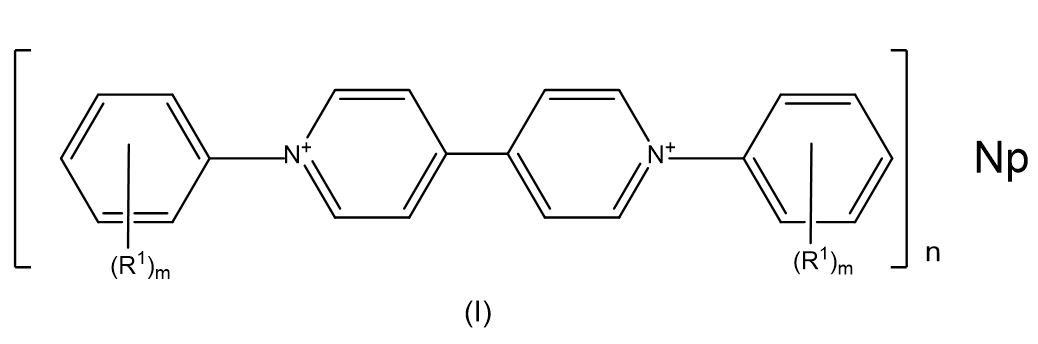
The invention involves an electrolyte based on a viologen compound, or its salt or solvate, where each nitrogen atom of the viologen is substituted with one aryl group. These aryl groups can be identical or different and may also be optionally substituted. This modification enhances the properties of the viologen, making it more stable and efficient for use in energy storage systems.
Additionally, the invention pertains to:
- A redox flow battery that uses this specially modified electrolyte.
- An energy storage and/or delivery system that includes this battery.
- A method for storing and/or delivering electricity using this battery.
- The use of the viologen compound or its salt/solvate as an active species in the electrolyte.
The research group is focused on generating advanced knowledge in the field of electrochemical energy storage. Its main lines of research include the study of new electroactive materials, the development and characterization of electrochemical storage systems, the optimization of electrochemical processes, and the fundamental analysis of transport and reactivity phenomena to advance battery technologies and efficient, sustainable energy systems.
The invention provides an improved, more stable and durable electrolyte, enabling efficient and reliable energy storage, while avoiding the instability of electrolytes in redox flow batteries under alkaline conditions.
Applications
Redox flow batteries for energy storage:
- Large scale energy storage: For integration with renewable energy sources such as solar or wind.
- Residential systems: Providing backup power or home storage.
- Electric mobility: Energy storage for electric vehicles.
- Hybrid applications: Combined use of redox flow batteries with supercapacitors that adapt to storage requirements.
New and innovative aspects
The key innovation is the modification of the viologen structure by replacing the nitrogen atoms with aryl groups. This modification alters the electronic properties of the carbon atom bonded to the nitrogen atoms, effectively preventing nucleophilic attack by hydroxyl anions, which would otherwise degrade the viologen.
This represents a significant advance in viologen derivative chemistry, offering improvements in:
Main advantages of its use
The use of the new electrolyte in flow batteries has the following advantages:
Specifications
wherein:
- R1 is selected from -Y, -OY, -COOY, -SY and -NY2,
wherein Y represents:
- H or an organic radical chosen from alkyl alkyl, alkenyl, alkynyl, acyl, aryl, alkylaryl, arylalkyl, alkylene oxide and alkyleneimine, optionally substituted with at least a substituent selected from the group consisting of F, Cl, Br, I, –CN, –OR’, –SR’ and, –NR’R’’, wherein R’ and R’’ are independently selected from H, alkyl, alkylene oxide and alkyleneimine;
- is an integer independently selected from 0 to 5;
- n and p, are ineger positive numbers, and
- N is an anion.
Desired business relationship
Commercial Agreement, License Agreement, Technical Cooperation: further development; Technical Cooperation: testing new applications; Technical Cooperation: adaptation to specific needs.
The aim of the Technology Transfer Office (TTO) of the Universidad de Burgos is to promote Innovative technology through the research results transfer and the connections between the University and the new needs and requirements of society - we are the link between the University and the Industry. Contact person: José Manuel López (jmllopez@ubu.es)
Create your free account to connect with UNIVERSIDAD DE BURGOS and thousands of other innovative organizations and professionals worldwide
Send a request for information
to UNIVERSIDAD DE BURGOS
Technology Offers on Innoget are directly posted
and managed by its members as well as evaluation of requests for information. Innoget is the trusted open innovation and science network aimed at directly connect industry needs with professionals online.
Need help requesting additional information or have questions regarding this Technology Offer?
Contact Innoget support