Adaptive headsail management system for multihull yachts — patent pending
Innovative Products and Technologies
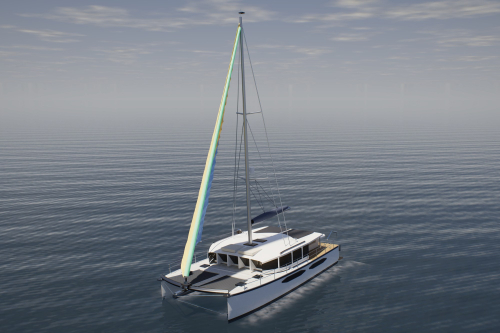
A Latvian independent inventor offers an adaptive sail management system (ASMS) for multihull yachts — catamarans and trimarans. A curved load-bearing track spans the bow, supported at the end of each hull — two points on a catamaran, three on a trimaran — plus the bowsprit. A powered carriage runs the full length of the track, so the tack of a single modular headsail follows the wind angle from close-hauled to running, while progressive furling of the sail's three zones matches the sail to wind strength.
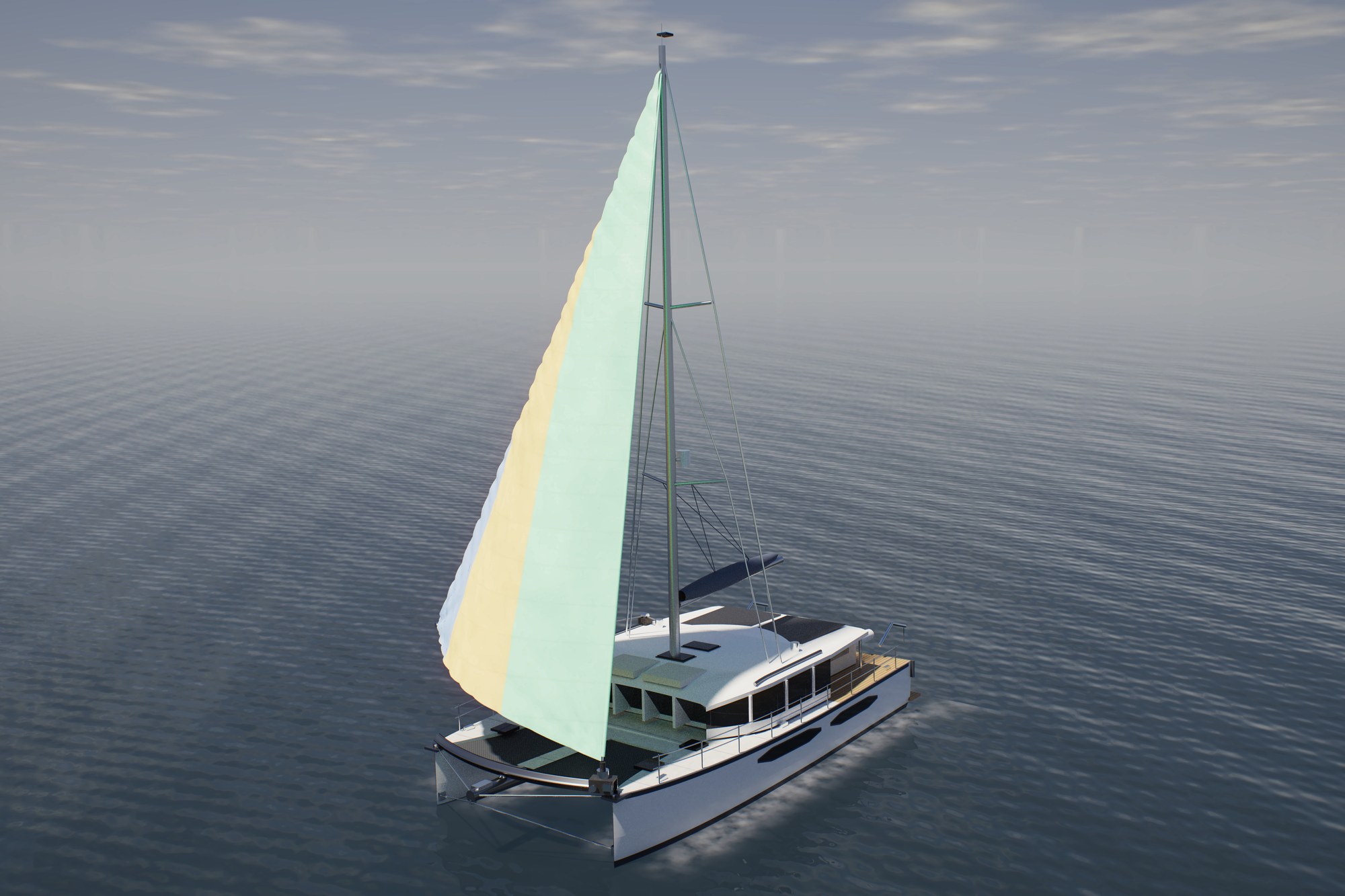
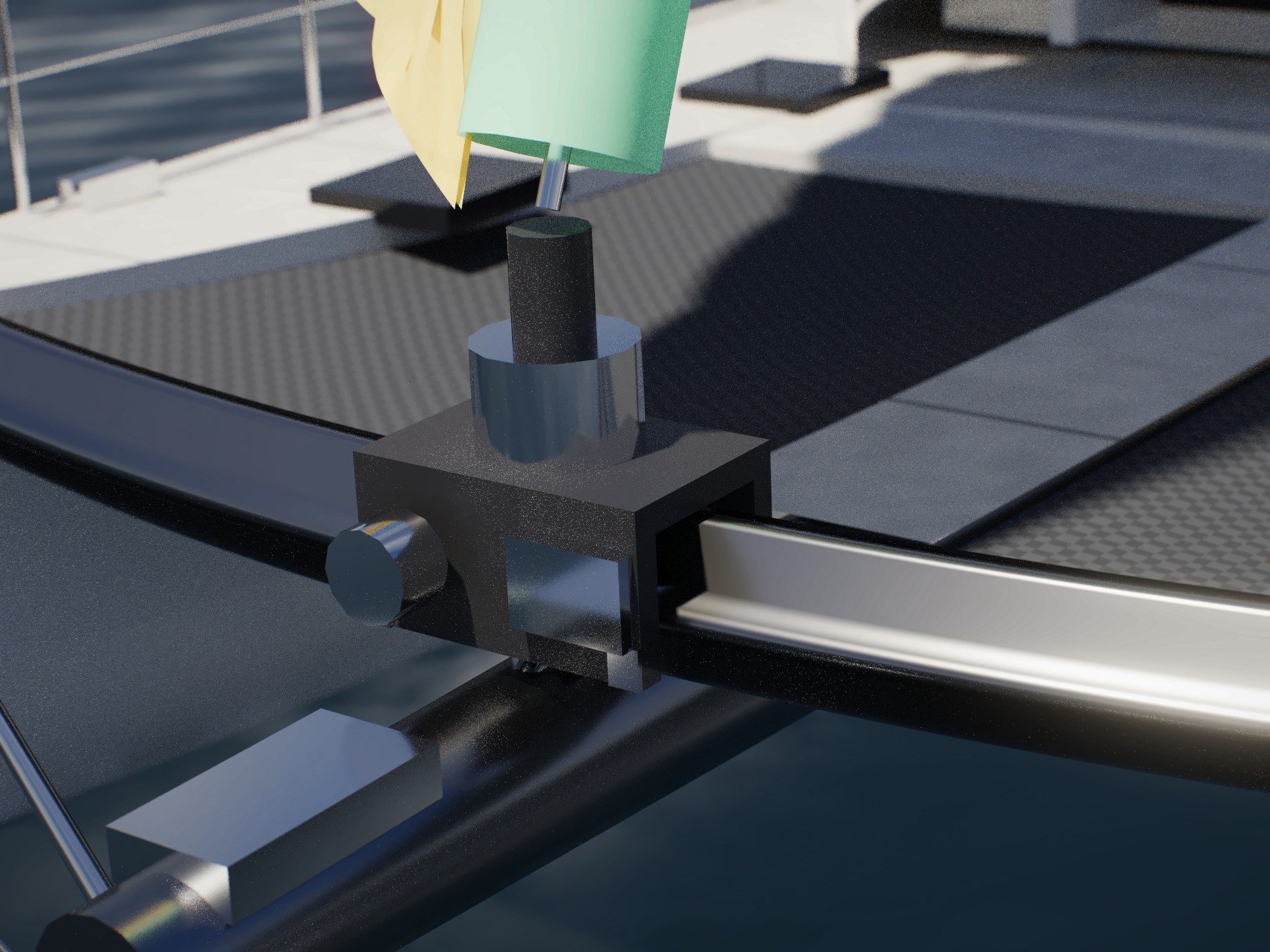

On a multihull yacht, changing headsails means going forward onto the foredeck — usually at the moment when conditions are at their worst. Existing headsail systems address part of this. A roller-furling headsail changes sail area, but not sail type, cloth weight or the position of the tack; a partly furled genoa performs less well than a sail designed for that wind strength. A self-tacking jib solves tacking, but gives one sail size. A second forestay or a separate Code Zero furler adds a second sail, but changing or setting it still means going forward. The adaptive sail management system addresses the remaining part of the problem: which sail is set, and where it is attached.
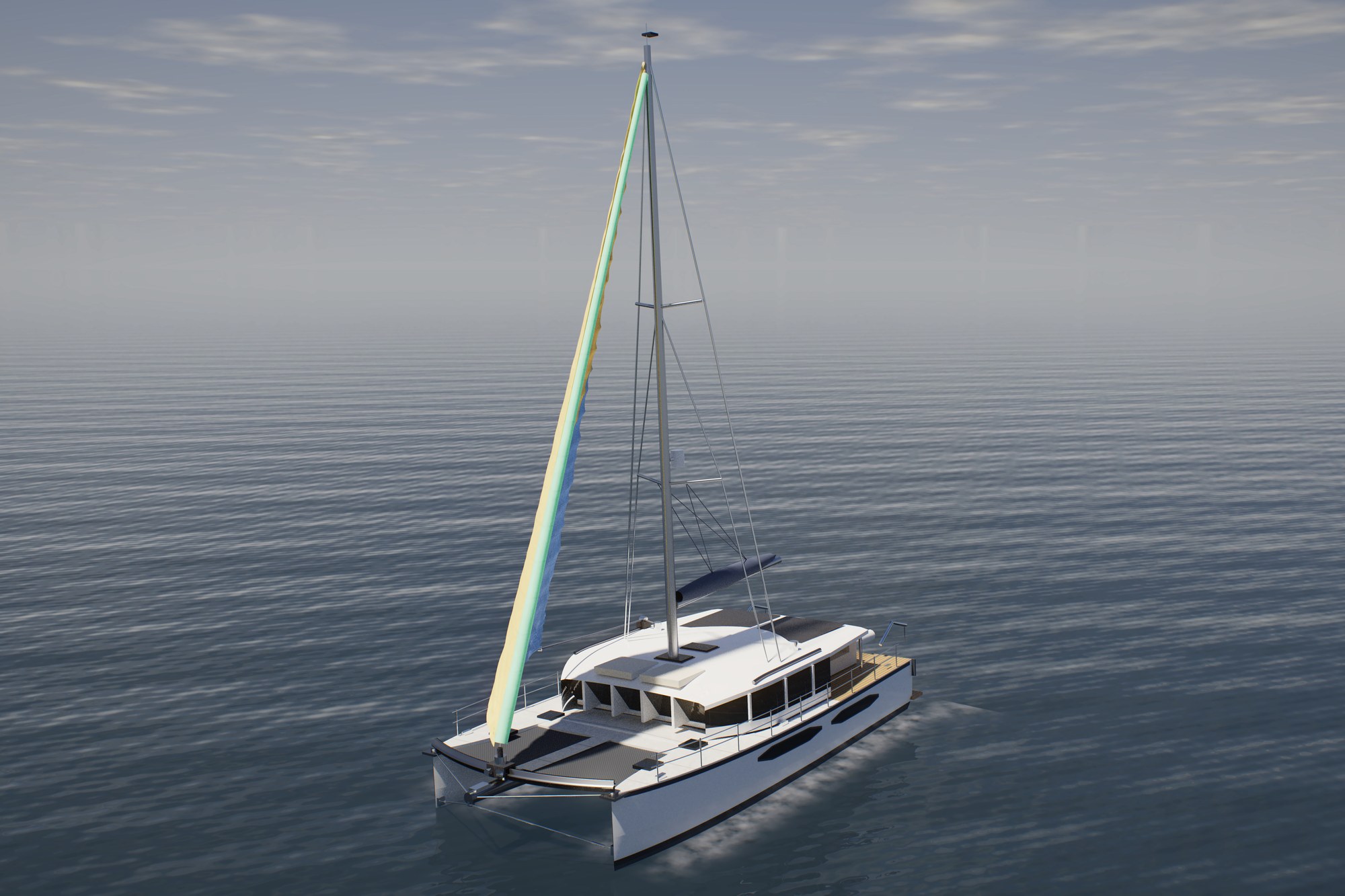
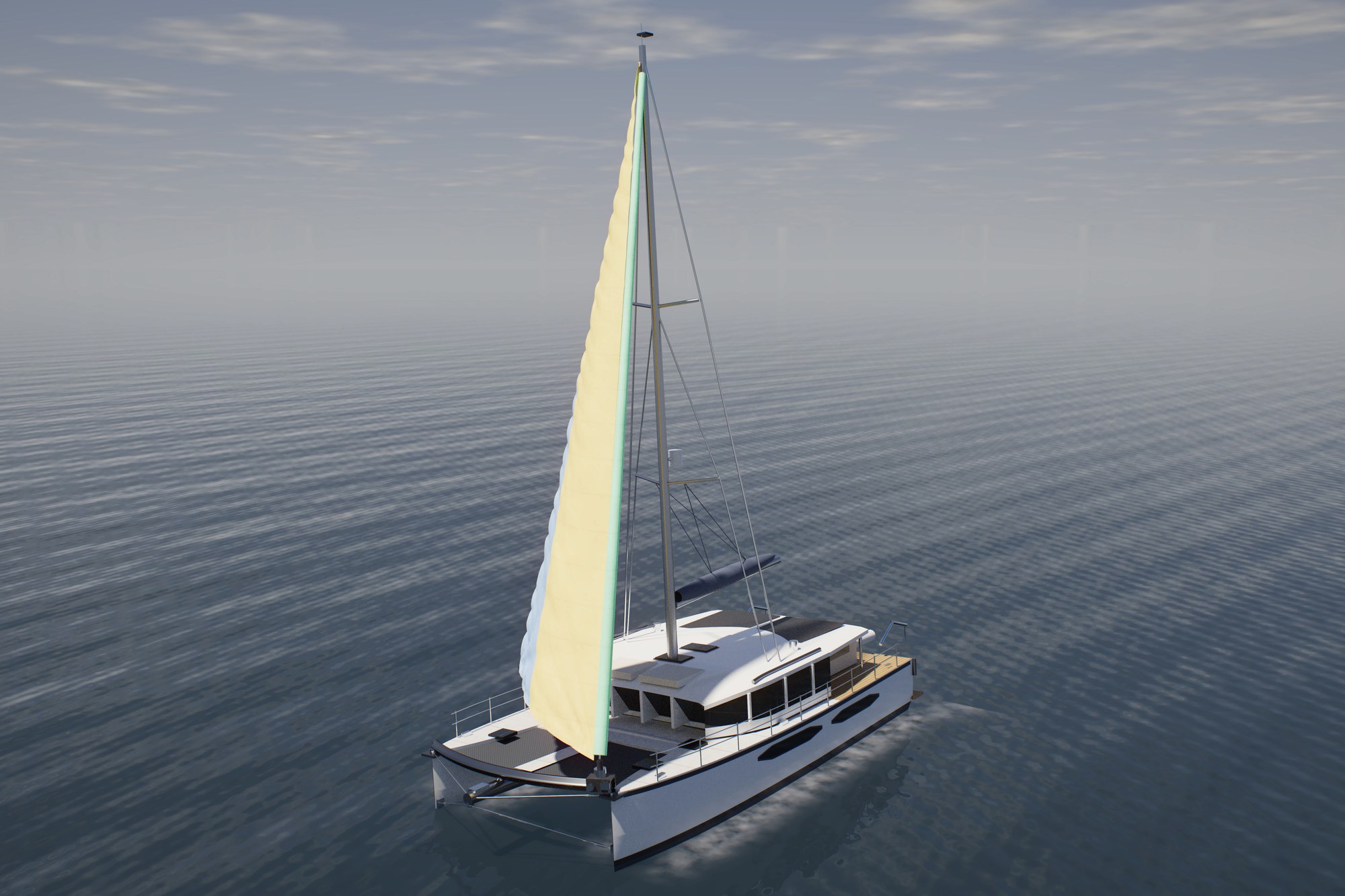
Configuration. A curved load-bearing track spans the bow of the yacht. It is fixed at the end of each hull — two points on a catamaran, three on a trimaran — and additionally supported on the bowsprit, so it rests on at least three points. A carriage, moved by an electric rack-and-pinion drive and held in position by a spring-applied brake, carries the tack along the whole length of the track and is commanded from the cockpit.
The sail. The headsail is modular, with three zones divided by boundaries parallel to the luff. Nearest the luff is a Code Zero and furling-spinnaker area in the lightest cloth; in the middle is a genoa area; and nearest the leech is a jib area in the heaviest, fully UV-protected cloth, which stays standing when the rest is rolled away. Furling takes in the luff-side zone first, then the middle zone, so what remains set is always the smallest and strongest part of the sail. Unrolling runs the other way: the jib area sets first, then the genoa area, and the Code Zero area last.
Two axes of adaptation. First, wind angle: the carriage moves the attachment point of the sail along the track, so the sail geometry follows the course from close-hauled to running. Second, wind strength: the stronger the wind, the more zones are furled in, leaving only the strongest, heaviest-cloth zone; in light air all three zones are unrolled. Between the full sail and the fully reefed state the sail is reduced in two steps, to roughly half and then to about a third of its full area, with the heeling moment falling correspondingly.
Result. One system replaces a set of several separate headsails, and the whole headsail plan is handled by one person from the cockpit, both when changing course and when the wind strength changes — without going forward onto the foredeck.
Designed parameters (base variant, 7 m track on a 7 m arc radius). Track cross-section 300 mm high and 300 mm wide; design load 2 t; material carbon fibre with a foam core, manufactured by vacuum infusion. The track is formed as two identical halves split along the horizontal axis, each moulded separately and bonded after surface preparation. Three sizes have been analysed and are retained: a 7 m track on a 5 m radius, a 7 m track on a 7 m radius (the base variant), and a 9 m track on a 9 m radius. For the base variant the yacht length class is about 16 m and the carriage travel about 6.6 m. Because the system's foretriangle base is the arc radius of the track rather than the conventional J measurement, the foretriangle is about 94 m2 and the headsail about 113 m2.
Scope of supply. The offer covers everything below the furler: the track, the carriage, the drive, the control system, the tack/furler pin with its bearing seat, the attachments to the hulls and bowsprit, and the slip-ring sleeve. The furler itself is a standard market component and the sail is made to order by the owner's sailmaker; neither is part of the supply.
Stage of development. The system is at engineering design stage, with calculated parameters, 3D models and an animation showing the wind angle changing from 45 to 180 degrees. Load calculations have been carried out for the design variants. A computer simulation of the whole yacht with the system has been carried out for the base variant, on 16 m catamaran and trimaran reference models: steady-state sailing across the range of wind speeds and angles, and time-domain scenarios with gusts, squalls, waves, tacks, gybes and component failures, checking the loads on the forestay, the track, its mounts and the drive against their design limits. The simulation results were used to refine the control logic. No prototype has been built and no sea trials have been carried out; simulation is not testing.
What is offered. The patent application with its priority date, together with the existing technical and other documentation, including the manufacturing know-how. Possible routes are assignment of rights, an exclusive licence, or joint development; the inventor is equally open to discussing other models proposed by the partner.
Intellectual property status
Patent pending. The international application PCT/LV2026/050019 "Adaptive sail management system for solo operation", filed 25 August 2026, is currently under examination; priority date 25 August 2025 (priority application LVP2025000080). The PCT route keeps the national phase open across the contracting states. Patent attorney: Anna Timofejeva, AAA Law, Latvia.
Current development status
Engineering design stage. Calculated design parameters, construction drawings, 3D models and an animation covering wind angles from 45 to 180 degrees are available. Curved rail 300 mm high and 300 mm wide, design load 2 t, lengths of 7, 9 and 11 m considered; carbon fibre with a foam core, vacuum infusion. No prototype has been built and no sea trials have been carried out so far.
Desired business relationship
Technology selling
Patent licensing
Joint ventures
Technology development
Open to assignment of rights, an exclusive licence, or joint development; the inventor is equally open to other models proposed by the partner. The package comprises the patent application with its priority date, design drawings and 3D models, engineering calculations, and manufacturing know-how. The full technical package can be shared under a mutual NDA. Please reply in writing.
Independent inventor based in Latvia, working on deck hardware and sail handling for multihull yachts — catamarans and trimarans. I have developed the Adaptive Sail Management System (ASMS): a curved rail across the bow with a travelling carriage and a modular three-zone headsail, which lets one person manage all headsails from the cockpit, both when the course changes and when the wind strength changes. The work is at engineering design stage, with calculated parameters, construction drawings, 3D models and an animation. The international patent application PCT/LV2026/050019 is currently under examination.

Create your free account to connect with Janis Zemitis and thousands of other innovative organizations and professionals worldwide
Send a request for information
to Janis
Technology Offers on Innoget are directly posted
and managed by its members as well as evaluation of requests for information. Innoget is the trusted open innovation and science network aimed at directly connect industry needs with professionals online.
Need help requesting additional information or have questions regarding this Technology Offer?
Contact Innoget support
