Dynamic control of three-dimensional light distributions through wavefront engineering: hardware and software system
Innovative Products and Technologies

Engineering light distributions in a three-dimensional volume to achieve selective illumination profiles is an instrumental task shared by many optical and microscopy techniques. The optimization of the light distribution can lead to significant enhancement of relevant performance figures and ultimately to the extension of the instrument or experimental protocol capabilities1,2,3,4,5. Targeted illumination profiles can be used either to mechanically interact with molecules at nanometer precision, as in an optical tweezer application, or to optically induce a change in the conformational state of molecules.
Technology enabling selective control of light distributions has found an ideal match in the field of optogenetics, enabling high resolution light-based control of neuron activity. This technique is rapidly developing, and was awarded as method of the year 2010 by Nature Methods and was named as one of the breakthroughs of the decade by Science Magazine. The precision and power of optogenetic approaches are limited by the degree of spatio-temporal control in the delivery of light. Using wavefront engineering, a very precise light field distribution can be generated in a three-dimensional volume. This enables neuroscientists to selectively target specific sets of neurons in vivo for activation, to explore neural circuits and connectivity. This is a cutting edge technique, which is only starting to reach the market, and would be a desired add- on module to many microscopes.
Technology
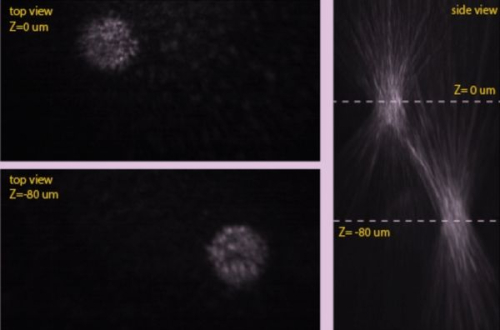
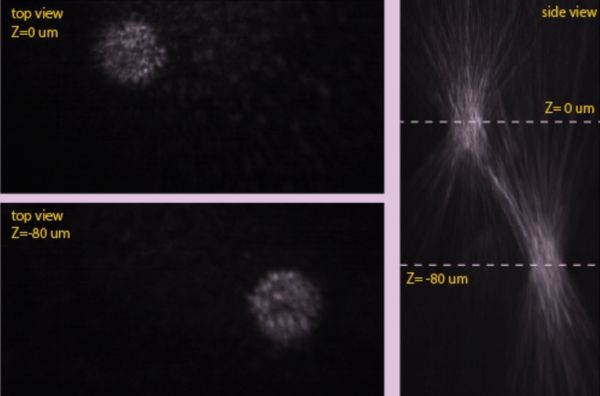
Scientists at the Max Planck Institute of Neurobiology engineered a dedicated optical path and a convenient software tool for the generation and control of three-dimensional light distributions according to user-selected patterns. The software comprises the following key features:
Benefits
Licensing Information
This control software is available through a non-exclusive license agreement with Max-Planck- Innovation, the tech-transfer agency of Max Planck Society.
Literature
PDF Download
As the central technology transfer company of the Max Planck Society, Max Planck Innovation has helped bridge the gap between science and industry since 1970.
The Max Planck Society (MPG) operates as Germany’s most successful organization in basic research and is worldrenowned for its cutting-edge research. In many cases this cutting-edge research also forms the basis for innovative products and services that are implemented through licensing and spin-off companies.
Max-Planck-Innovastion advises and supports scientists of the Max Planck Society in the assessment of inventions and filing of patents. We also market patents and technologies to industry, while coaching founders on how to build up new companies based on the research results of the Max Planck Society.
Create your free account to connect with Max-Planck-Innovation GmbH and thousands of other innovative organizations and professionals worldwide
Send a request for information
to Max-Planck-Innovation GmbH
Technology Offers on Innoget are directly posted
and managed by its members as well as evaluation of requests for information. Innoget is the trusted open innovation and science network aimed at directly connect industry needs with professionals online.
Need help requesting additional information or have questions regarding this Technology Offer?
Contact Innoget support