CellNetAnalyzer: A Software Package for Analyzing Structure and Function of Cellular Networks
Innovative Products and Technologies

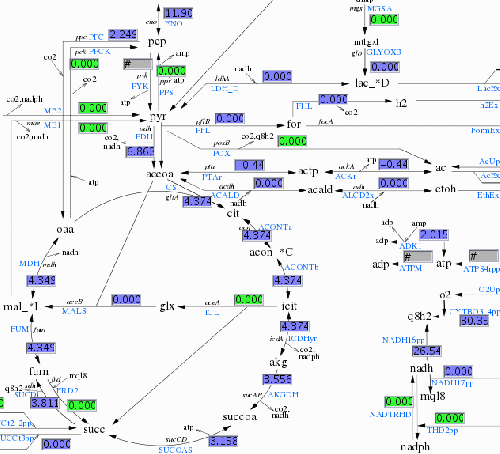
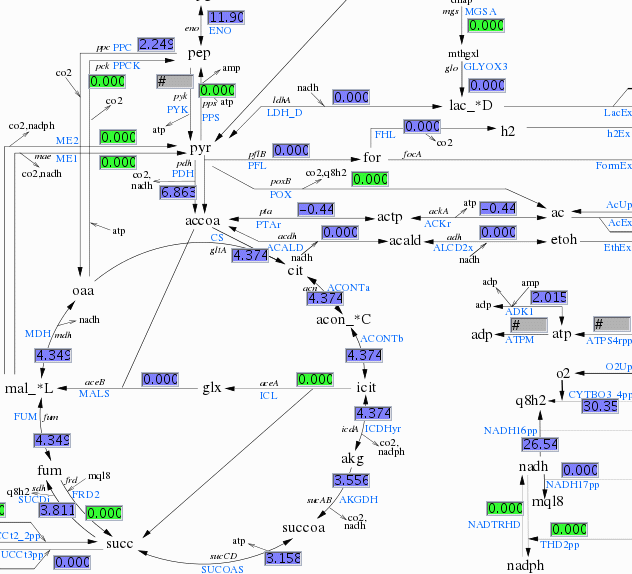
CellNetAnalyzer (CNA) is a MATLAB toolbox providing various computational methods for analyzing structure and function of metabolic, signaling, and regulatory networks. For metabolic networks, CNA supports a variety of stoichiometric and constraint-based modeling techniques, including flux balance analysis (FBA), metabolic flux analysis, elementary-modes analysis, or computational strain design (e.g., minimal cut set analysis). Signal transduction and (gene) regulatory networks can be represented as logical networks (Boolean or multivalued logic) and as interaction graphs and be explored through logical steady state analysis (qualitative input-output behavior of signaling networks), minimal intervention sets, discrete simulations, simulation of logic-based ODEs (via ODEfy plugin) as well as analysis of global interdependencies and of feedback loops and signaling paths. Computations can be started within a GUI (interactive network maps) or from command line (via API functions). logy, metabolic engineering, pharmacology, microbiology, chemical engineering.
General Information
CellNetAnalyzer has been developed by Steffen Klamt, Axel von Kamp and several other contributors at the Max Planck Institute for Dynamics of Complex Technical Systems in Magdeburg.
A full description of the current available software can be found under
https://www2.mpi-magdeburg.mpg.de/projects/cna/description.html
The requirements for using CellNetAnalyzer are:
An English manual is available and can be found here
An English Tutorial (for Metabolic Network Analysis with CellNetAnalyzer) can be found here.
CellNetAnalyzer - Detailed Description
CellNetAnalyzer is a MATLAB toolbox for analyzing structure and function of biological networks on the basis of topological, stoichiometric, qualitative and semi-quantitative modeling approaches requiring no or only few parameters. In particular, up to genome-scale metabolic networks (mass-flow networks) can be studied based on stoichiometric and constraint-based modeling approaches whereas signaling and regulatory networks (signal-flow networks) can be explored by qualitative and semi-quantitative modeling approaches (Boolean/logical models, interaction graphs, logic-based ODEs). CNA can be used via a graphical user interface with embedded network visualizations (interactive network maps) or vial command-line based operations (supported by an application programming interface (API)).
Here is an (incomplete) list of features and of (GUI and API) functions in CellNetAnalyzer:
Mass-flow (stoichiometric, metabolic) networks:
Analysis of basic topological/structural properties
Metabolic flux analysis
Flux balance analysis (FBA; flux optimization)
Metabolic pathway analysis / Elementary-modes analysis
Minimal cut sets
Signal-flow (signaling, regulatory) networks:
Analysis of interaction graphs
Analysis of logical (Boolean) interaction networks
General features (for mass-flow and signal-flow networks):
Price list for CellNetAnalyzer
ACADEMIC USE (1) | INDUSTRY | |
Single user + source code (*) | free | 3.000,-- |
Site license source code (**): |
|
|
Prices do not include value added tax (VAT).
(1) Academic use: free academic license.
Here you can download CellNetAnalyzer for academic use.
(2) US-prices: Payments in US $ are welcome and will be based on the actual exchange rate EUR / US $. Please ask the contact person for further details.
(*) includes executable software, the source code and a manual in PDF format, to be used on one PC only, copies for backup purposes only
(**) includes executable software, the source code and a manual in PDF format, to be used on the limited number of PC only, copies for backup purposes only
The purchase comprises the actual version and the next update, e.g. purchaser of version 2020.2 receives 2020.3 free of charge.
Academic institutions are universities, non-profit research laboratories, and schools.
Publications on CellNetAnalyzer
Dr. Lars Cuypers
Senior Patent- & License Manager
Chemist
Email: cuypers@max-planck-innovation.de
As the central technology transfer company of the Max Planck Society, Max Planck Innovation has helped bridge the gap between science and industry since 1970.
The Max Planck Society (MPG) operates as Germany’s most successful organization in basic research and is worldrenowned for its cutting-edge research. In many cases this cutting-edge research also forms the basis for innovative products and services that are implemented through licensing and spin-off companies.
Max-Planck-Innovastion advises and supports scientists of the Max Planck Society in the assessment of inventions and filing of patents. We also market patents and technologies to industry, while coaching founders on how to build up new companies based on the research results of the Max Planck Society.

Create your free account to connect with Lars Cuypers and thousands of other innovative organizations and professionals worldwide
Send a request for information
to Lars
Technology Offers on Innoget are directly posted
and managed by its members as well as evaluation of requests for information. Innoget is the trusted open innovation and science network aimed at directly connect industry needs with professionals online.
Need help requesting additional information or have questions regarding this Technology Offer?
Contact Innoget support