Autonomous vehicle for explosive detection
Patents for licensing

The threat of improvised explosive devices (IEDs) in public spaces such as airports, transportation hubs, or logistics warehouses represents a growing risk to public safety. Many of these devices use TATP (triacetone triperoxide), a highly unstable and volatile homemade explosive. Unlike other conventional explosives, TATP does not contain nitro groups, which makes it difficult to detect using common technologies such as mass spectrometry, traditional chemical sensors, or even trained dogs. This limitation can create a gap in current surveillance systems, especially in environments where large-scale physical inspection is not feasible.In this context, a research group from the University of Burgos (UBU) has developed a portable technology that enables the selective detection of TATP in the air, offering an effective, more affordable, and non-invasive solution to enhance security in public spaces.
New and innovative aspects
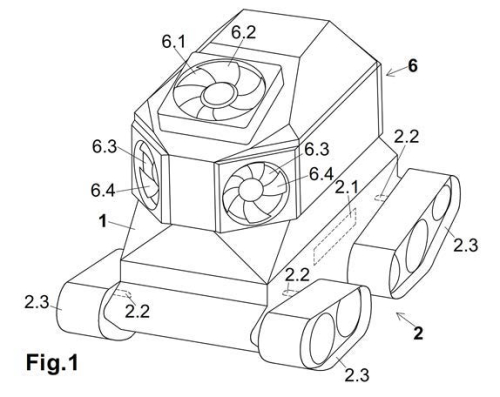
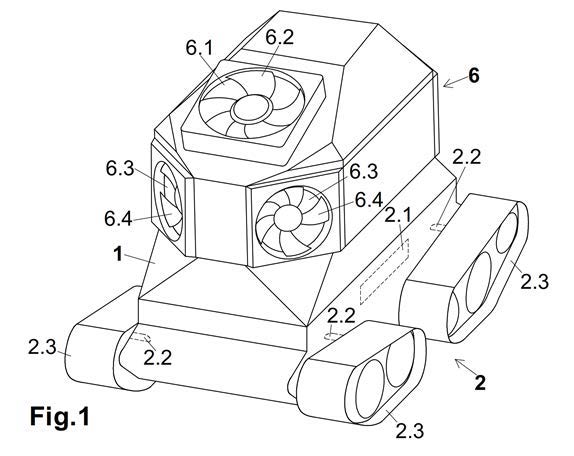
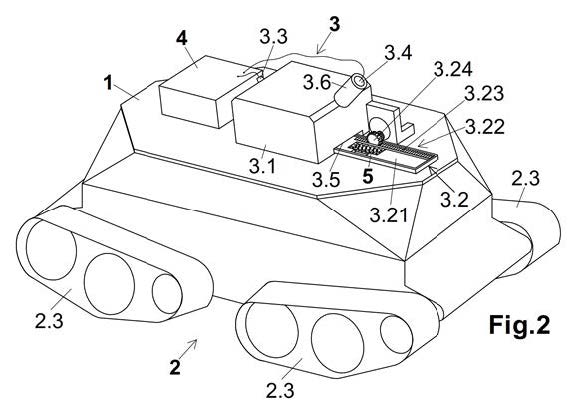
The technology uses organic dyes that change their fluorescence upon contact with TATP or its byproduct, H₂O₂.The system is integrated into a mobile indoor robot that draws in ambient air and analyzes potential changes in fluorescence using a mini colorimeter. If traces of the explosive are detected, a visual and audible alarm is triggered.It offers continuous, contactless detection with very high sensitivity, representing a cost-effective and non-invasive alternative to technologies such as mass spectrometry or sniffer dogs.
Main advantages of its use
Specifications
This autonomous robot is equipped with a fluorescence-based chemical detection system, capable of identifying traces of TATP with high precision. Its intelligent mobile platform allows it to move autonomously in challenging terrains, while its compact design enables access to restricted spaces. The autonomous vehicle detects TATP by capturing airborne particles through a support with a fluorescence-sensitive compound. The support is placed in a detection chamber where an ultraviolet light source and a fluorimeter measure the fluorescence of the TATP particles. First, a reference measurement is taken without TATP, and then it is measured again after exposing the support to air containing TATP. The comparison of both measurements allows for the detection of TATP.
Applications
This autonomous robot is well-suited for use in high-security environments such as airports, stations, and large events, where early detection of explosives is crucial.
Its autonomous operation makes it a key tool for security forces, bomb disposal units, and emergency response teams, enabling rapid response without endangering personnel.
Additionally, its compact design makes it perfect for interventions in confined or hard-to-reach areas, such as critical infrastructures or conflict zones.
Current development status
Device already developed and validated for industrialization.
Desired business relationship
Commercial Agreement, License Agreement, Technical Cooperation: further development; Technical Cooperation: testing new applications; Technical Cooperation: adaptation to specific needs.
The aim of the Technology Transfer Office (TTO) of the Universidad de Burgos is to promote Innovative technology through the research results transfer and the connections between the University and the new needs and requirements of society - we are the link between the University and the Industry. Contact person: José Manuel López (jmllopez@ubu.es)

Create your free account to connect with Universidad de Burgos and thousands of other innovative organizations and professionals worldwide
Send a request for information
to Universidad
Technology Offers on Innoget are directly posted
and managed by its members as well as evaluation of requests for information. Innoget is the trusted open innovation and science network aimed at directly connect industry needs with professionals online.
Need help requesting additional information or have questions regarding this Technology Offer?
Contact Innoget support