Non-fluorinated water-repellent formulation for dry cleaning
Innovative Products and Technologies
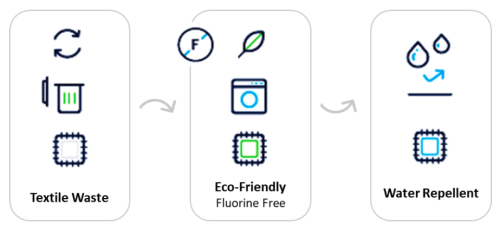
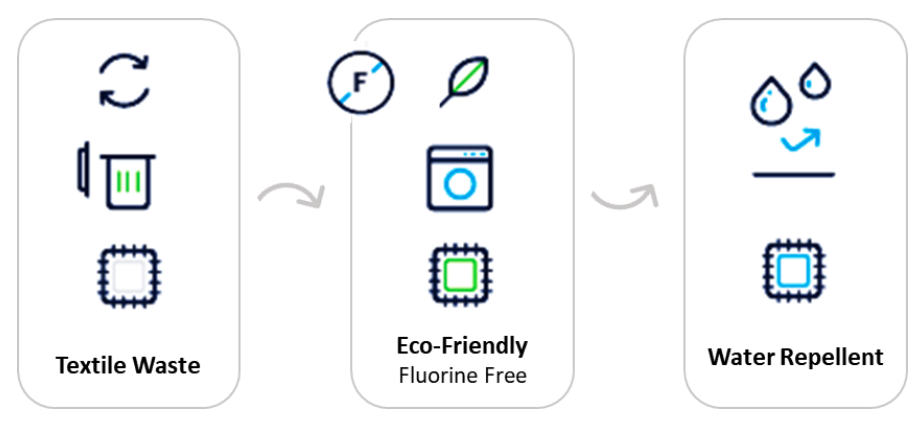
The technology developed is based on the use of a new cellulose derivative (Long-chain Cellulose Ester - LCCE) as a totally eco-friendly non-fluorinated hydrophobic additive for dry-cleaning water repellency finishes in any type of textile composition: cotton, synthetic textiles and mixtures thereof. This new additive/formulation can be applied for repellent/water proofing finish on clothes by the simple and conventional dry-cleaning process. Additionally, there is no need to use of crosslinkers to anchor the additive to textiles, nor pre-treatments. Hydrophobic (repellent) textiles are thus obtained, with easy and self-cleaning properties, through a traditional dry-cleaning process totally fluorine free.
Background:
The demand for garments with easy-cleaning/self-cleaning properties has been increasing. These functionalities are directly related to the repellency (hydrophobicity) of the substrate. On textiles, the repellent finishes are achieved through compounds that, upon adsorption onto the fibres, reduce the associated surface Gibbs energy. These compounds are generally polysiloxanes, organosilanes, polytetrafluoroethylene, fluorinated polyacrylates, or fluorosilicones, with great prevalence for fluorinated compounds. However, fluorinated compounds have negative effects on the environment and also the modification of the surface by these processes implies a pre-treatment or the use of other additives such as crosslinkers. On the other hand, in synthetic fibers generally the anchoring of these finishes is very difficult to achieve, limiting these approaches to cotton fabrics.
Benefits:
Potential comercial use/applications: Dry-cleaning processes.
U.Porto Inovação was established in 2004 to support the University’s innovation value chain by facilitating the transfer of knowledge and strengthening the relationship between the University and businesses. With over 20 years of experience, U.Porto Innovation focuses its activities on research at the University, entrepreneurship within the academic community and U.Porto’s growing connections with industry.
Create your free account to connect with University of Porto and thousands of other innovative organizations and professionals worldwide
Send a request for information
to University of Porto
Technology Offers on Innoget are directly posted
and managed by its members as well as evaluation of requests for information. Innoget is the trusted open innovation and science network aimed at directly connect industry needs with professionals online.
Need help requesting additional information or have questions regarding this Technology Offer?
Contact Innoget support