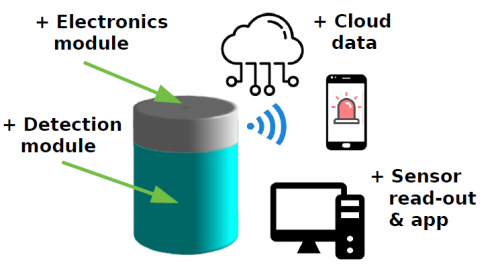
LIGHTWEIGHT NEUTRON DOSIMETER
Patents for licensing
 FISABIOFISABIO
Technology Transfer Network from Spain
FISABIO (Foundation for the Promotion of Health and Biomedical Research in the Valencian Community) is a nonprofit scientific and healthcare organisation. Our primary purpose is to encourage, promote and develop scientific and technological research in health and biomedicine within the Valencian Community (Alicante, Valencia, Castellon). FISABIO integrates and manages the Health Research Map of the Valencian Community Centre for Public Health Research (FISABIO-Public Health) as well as of several University Hospitals (Foundation of Dr Peset University Hospital, Foundation of the University General Hospital of Alicante, Foundation of the University General Hospital of Elche and the Mediterranean Ophthalmological Foundation). Also, FISABIO assumes the scientific and research activities of other 18 Health Departments spread across the Valencian Community. FISABIO provides scientific support services to more than 1,500 health care professionals and medical specialists within the Valencian Community network, whose research projects and clinical trials are managed by our Foundation. Also, from July 2013, FISABIO provides Ophthalmological Assistance in our headquarter FISABIO-Ophthalmological Foundation. The main goals of FISABIO are: - To facilitate, promote, develop and execute research according to existing research plans in the Regional Department of Health of the Valencian Community. - To act as a driving agent of scientific and technological research and innovation, providing the necessary scaffold to promote successful interactions between research teams located in different institutions including Universities, Hospitals, and the Scientific Research Council of Spain (CSIC). - To facilitate and promote the training of Healthcare professionals and researchers. - To promote and perform various research studies in Healthcare and Public Health. - To develop and cooperate in the development of Healthcare activities. Instituto de Productos Naturales y AgrobiologíaInstituto de Productos Naturales y Agrobiología
Research & Technology Organization from Spain
Los fines del IPNA son la investigación científica y tecnológica, la transferencia de conocimiento a la industria y a la sociedad, la formación de personal investigador y la divulgación de la ciencia a la sociedad. El IPNA se funda en 1990, año en el que se acordó la fusión de dos centros propios, el Instituto de Productos Naturales Orgánicos (IPNO) y el Instituto de Recursos Naturales y Agrobiología (IRNA), el primero del ámbito de Química y Tecnologías Químicas y el segundo perteneciente al área de Ciencias Agrarias. The Garvan Institutes of Medical ResearchThe Garvan Institutes of Medical Research
Non-Profit Research Organization from Australia
For more than 50 years the Garvan Institute of Medical Research has pioneered insights into some of the most widespread diseases affecting our community today. Garvan's mission is to make significant contributions to medical research that will change the directions of science and medicine and have major impacts on human health. Garvan strives to enhance and develop research programs that combine fundamental science with strong clinical interactions. Research at Garvan is focused upon understanding the role of genes and molecular and cellular processes in health and disease as the basis for developing future preventions, treatments and cures. For over 50 years, significant breakthroughs have been achieved by Garvan scientists in the understanding and treatment of diseases such as: * Cancer * Diabetes and obesity * Neurological diseases such as Alzheimer's, Parkinson's, hearing loss, mental illnesses and eating disorders * Osteoporosis * Immunological diseases such as asthma, rheumatoid arthritis, multiple sclerosis and Sjogren's syndrome Garvan's ultimate goal is prevention, treatment or cure of these major diseases. Medical University of ŁódźMedical University of Łódź
Technology Transfer Office from Poland
The Medical University of Lodz – mission, vision and values Mission The Medical University of Lodz provides the best possible conditions for students in the course of education. The University conducts research characterized by outstanding quality and supports the development of its employee. It responds to the demands of the environment, particularly patients and entities rendering health services, by updating its range of educational and research services. It makes a substantial contribution to the development of the health care system by promoting modern standards of prophylaxis and treatment, and by building long-lasting cooperation with institutions realizing objectives of public health at regional, national and international levels. Vision The Medical University of Lodz will be recognizable and attractive research and didactic centre in the European Research Area focused on the promotion of research and development of innovative pro-health solutions for a society facing epidemiological and socio-demographic issues. The University will become an effectively managed organization taking advantage of specialist information technology systems, which will allow for the optimal management of available resources. Its graduates will be highly desirable and appreciated on the labour market as professionals who are highly qualified in modern Medicine and observe the requirements of professional ethics. The vision of the university development will be realized in compliance with the Development Strategy of the Medical University of Lodz for the period 2015 – 2020. Values In all fields of activity, the Medical University realizes its goals in accordance with traditional academic and cultural values. The University strives to provide high-quality education and research. However, it also maintains the principles of freedom and intellectual property rights. During the education process, the University promotes good attitudes, guided by the patient and respect for patient rights. University employees and students abide by standards of professional ethics and care about the positive image of the University. Key values of the organization include openness, quality and effectiveness. The Medical University of Lodz is an open institution, which implements quality standards to all areas of its activity and cares about the development of its own resources and their effective application. The Development Strategy of the Medical University of Lodz will be realized in four strategic areas: education, research and development, collaboration in the development of the health care service, management and organizational development. International Iberian Nanotechnology Laboratory (INL)International Iberian Nanotechnology Laboratory (INL)
Research & Technology Organization from Portugal
The International Iberian Nanotechnology Laboratory (INL) is the first Intergovernmental Organisation in Europe in the fields of Nanotechnology and Nanoscience. It is the result of a joint decision of the Governments of Portugal and Spain. Aiming to become a vital part of Europe’s scientific area, the INL provides a state of the art research environment addressing major challenges in nanomedicine, nanotechnology applied to environmental & food control nanoelectronics, and nanomachines and molecular manipulation at the nanoscale. The INL seeks to advance the boundaries of knowledge in Nanoscience and Nanotechnology, developing and transforming the associated technologies, through research and innovation, human capital development, and collaborative work, for the discovery of new knowledge and the creation of societal value and wealth. The INL seeks strong collaborations with industrial partners and academic research institutions, through active participation in international research programs. The INL is located in Braga, northern Portugal. The campus is 47.000 m2 and will be home to 200 scientists, about 100 PhD students, and supporting technical and administrative staff. The built area is about 26,000 m², comprising several laboratories with state-of-the-art equipment, among which a class 100 Central Micro and Nanofabrication Clean Room of circa 600 m². Ozyegin UniversityOzyegin University
Technology Transfer Office from Turkey
As a research university, Özyeğin University always opens new horizons and presents new opportunities to students to enable them to discover their true competencies. In a quest to have its graduates stand out and be one step ahead of others, Özyeğin offers an innovative education model that adds value to its students. Özyeğin University’s primary mission is to prepare its students to be resourceful graduates in the world of business, making sure that they know more than one foreign language, acquire new skills through social activities, continuously develop themselves, expand their global vision before graduation through international internship or exchange programs, and always be at the service of society. IRST IRCCSIRST IRCCS
 IISPVIISPV
 University Hospital Hradec kraloveUniversity Hospital Hradec kralove
Technology Transfer Office from Czech Republic
The University Hospital Hradec Králové is a top health facility, a kind of a “flagship” of Czech health service. The Hospital has gone through a stage of development of its capacity and represents a basis providing superspecialized care in a number of cases of the whole-republic catchment area, which follows from its position as the faculty hospital in the system of Czech health service. In addition, it also serves as a municipal and district hospital cooperating with the hospitals of the Region of Hradec Králové. The research activities at University Hospital are focused on following topics: biomarkers and bioindicators in clinical medicine, advanced diagnostics, surgery of trauma and oncosurgery, aging and care for the elderly population, neurodegenerative diseases, personalized medicine. The University of Veterinary and Pharmaceutical Sciences Brno was founded in 1918. At the moment the university consists of three faculties - Faculty of Veterinary Medicine, Faculty of Veterinary Hygiene and Ecology, and Faculty of Pharmacy. The VFU Brno is the only university in the Czech Republic specializing in veterinary medicine, veterinary hygiene and ecology, and just one of two teaching pharmaceutical science. It is found within the City of Brno in the city district of Brno - Královo Pole, in the university campus, where all educational and research facilities are located. Raul RuanRaul Ruan Aude de ClercqAude de Clercq Steve GilbertSteve Gilbert
 FLUIDRAFLUIDRA Rinku HasanRinku Hasan